2025.08.11
 Blog
Blog
Content
In a variety of industrial, commercial, and healthcare environments, cleanliness is paramount. The need for effective, reliable cleaning materials is constant, whether it’s for managing spills, wiping down equipment, or maintaining overall hygiene. Among the many options available, white perforated roll nonwoven industrial light-duty general cleaning towels stand out for their versatility and performance. These towels are widely used for tasks ranging from spill control on factory floors to routine maintenance in kitchens and healthcare facilities. However, what goes into making these towels so effective, and why are they so reliable?
This article explores the science behind the production of white perforated roll nonwoven industrial light-duty general cleaning towels—from raw material selection to manufacturing processes, and the chemicals used to give these towels their unique properties. By gaining a better understanding of how these towels are made, we can appreciate why they have become indispensable tools in various industries and why they excel at tasks requiring high absorbency, durability, and a lint-free finish.
Before we dive into the specifics of white perforated roll nonwoven industrial light-duty general cleaning towels, it’s essential to understand the concept of nonwoven fabrics. Nonwoven fabrics are created through the bonding of fibers via mechanical, thermal, or chemical processes, rather than through traditional weaving or knitting. This unique manufacturing method eliminates the need for intricate weaving techniques, allowing for quicker, more cost-effective production. The result is a fabric that can be engineered for specific purposes—such as high absorbency, strength, and durability—making it an ideal choice for cleaning applications.
Two of the most commonly used types of nonwoven fabrics for cleaning towels are spunlace and meltblown. The spunlace process involves using high-pressure water jets to entangle fibers, creating a strong, cloth-like fabric that is soft and lint-free. This method ensures durability, making it perfect for general cleaning. On the other hand, meltblown involves extruding molten polymer fibers and blowing them with hot air to form a fine web of fibers. This results in a highly absorbent fabric, making meltblown nonwoven towels suitable for handling larger spills or liquids.
| Feature | Spunlace Nonwoven | Meltblown Nonwoven |
|---|---|---|
| Bonding Method | High-pressure water jets | Thermal bonding (fiber entangling) |
| Fiber Structure | Strong, entangled fibers | Fine, randomly arranged fibers |
| Absorbency | High | Very High |
| Tensile Strength | Excellent | Lower |
| Typical Use | Wipers, general cleaning | Absorbent pads, filtration, oil spills |
The performance of white perforated roll nonwoven industrial light-duty general cleaning towels depends largely on the choice of raw materials. Manufacturers carefully select and sometimes blend different fibers to create towels that strike the perfect balance between strength, absorbency, and durability.
The primary fibers used in nonwoven industrial cleaning towels include Polypropylene (PP), Polyester (PET), and Cellulose. Each of these fibers offers distinct characteristics that contribute to the towel’s final properties:
Polypropylene (PP): This synthetic polymer is known for its strength, low cost, and hydrophobic nature. It’s often treated with chemical additives to increase its absorbency. Its inherent water-repellent properties make it durable, making it ideal for basic cleaning tasks.
Polyester (PET): Known for its exceptional tensile strength, Polyester resists wear and tear, making it perfect for heavy-duty cleaning jobs. It is also highly resistant to chemicals, which makes it effective in industrial settings where harsh substances may be present.
Cellulose: A natural fiber derived from wood pulp, Cellulose is highly absorbent, making it ideal for cleaning tasks that require liquid retention. When combined with synthetic fibers like polypropylene, it enhances the overall absorbency and performance of the towel.
By combining these fibers, manufacturers can tailor the final product to meet specific performance needs—strength for heavy-duty jobs and absorbency for quick spill control.
In addition to the raw fibers, manufacturers use a range of chemical additives to further enhance the performance of these towels. For instance:
Wetting agents: These are added to hydrophobic fibers like Polypropylene to increase their absorbency. Without these agents, the fibers would simply repel liquids, limiting their usefulness in cleaning tasks.
Softening agents: To ensure the towels are gentle on surfaces and comfortable to use, manufacturers often add softening agents. These agents reduce the abrasiveness of the material, ensuring it’s effective but non-damaging.
Antimicrobial treatments: In industries like healthcare or food service, antimicrobial treatments may be used to inhibit the growth of bacteria and fungi on the towels. This feature is particularly important for environments where sanitation is a top priority.
The creation of white perforated roll nonwoven industrial light-duty general cleaning towels is a multi-step process that involves a combination of advanced textile engineering and precision machinery. This ensures consistent performance and high-quality results for each batch produced.
The first critical step in manufacturing these towels is creating the nonwoven fabric. Manufacturers can use either the spunlace or meltblown process to form the fabric, depending on the desired properties of the finished product.
Spunlace: In this process, fibers are arranged into a web and entangled using high-pressure water jets. This process is highly effective for creating strong, durable, and lint-free fabrics, making it ideal for white perforated roll nonwoven industrial light-duty general cleaning towels that need to withstand frequent use without falling apart.
Meltblown: This process involves extruding molten polymer fibers through tiny nozzles and blowing them with hot air. The result is an extremely fine, absorbent fabric. While meltblown materials are typically used for tasks requiring higher liquid retention, they are sometimes incorporated into cleaning towels designed for tasks like oil spill clean-up.
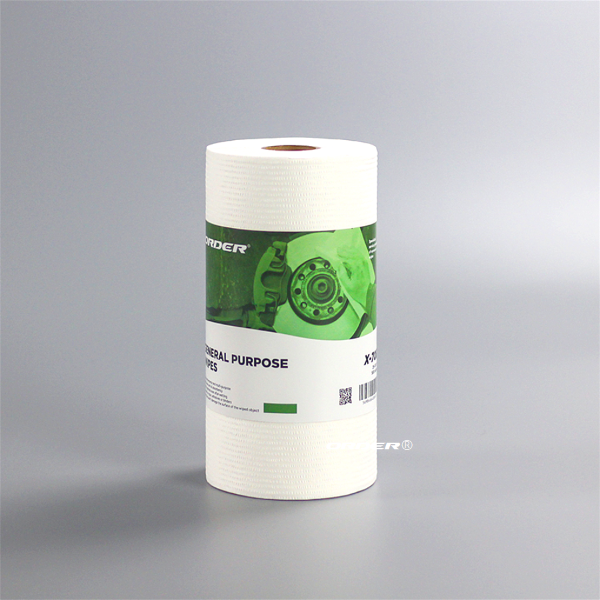
Once the nonwoven fabric is formed, it moves to the perforating machine. This is the step that defines white perforated roll nonwoven industrial light-duty general cleaning towels. Specialized dies or rotating blades create perforations at regular intervals along the fabric. These small holes allow the towels to be easily torn off the roll, ensuring each sheet is uniform in size and easy to access during use.
After perforation, the fabric is passed through a slitting machine that cuts the material into narrower widths. These narrower strips are then rolled tightly onto cores, ready for packaging. The rolling process ensures the fabric remains secure and prevents unraveling, allowing users to pull off one towel at a time with minimal effort.
To ensure that every white perforated roll nonwoven industrial light-duty general cleaning towel meets the required performance standards, rigorous quality control procedures are implemented throughout the manufacturing process. These tests are conducted to ensure each towel has the right combination of strength, absorbency, and durability.
Several tests are performed to measure key attributes:
Tensile strength: This test determines how much force the towel can withstand before tearing. It ensures that the towel remains intact during use, even when subjected to pulling or scrubbing.
Absorbency: Absorbency is measured by determining how much liquid the towel can absorb and how quickly it can soak it up. This directly correlates to the towel’s effectiveness in spill control and general cleaning.
Linting: For lint-free towels, the degree of fiber shedding is rigorously tested. This is particularly important for tasks involving sensitive equipment or surfaces where even a small stray fiber could cause problems.
Manufacturers also adhere to external certifications and industry standards, such as those from ISO (International Organization for Standardization), to validate their product’s quality. These certifications ensure that the manufacturing process is up to global standards, covering aspects such as safety, performance, and environmental responsibility.
The versatility of white perforated roll nonwoven industrial light-duty general cleaning towels makes them indispensable across numerous industries. From manufacturing plants to healthcare settings, these towels perform a wide range of cleaning tasks effectively.
In industrial environments, these towels are frequently used for cleaning machinery, absorbing spills, and wiping surfaces. Their durability and absorbency ensure that they can handle large volumes of liquids, including oil and grease, without disintegrating.
In commercial settings, such as restaurants, hotels, and hospitals, these towels provide an effective solution for general housekeeping and sanitation tasks. Their single-use nature makes them an attractive option for maintaining hygiene, preventing cross-contamination in places where cleanliness is essential.
Compared to traditional rags or paper towels, white perforated roll nonwoven industrial light-duty general cleaning towels offer distinct advantages:
Absorbency and Strength: These towels can absorb large volumes of liquid without tearing or falling apart, making them ideal for heavy-duty cleaning.
Lint-Free: The nonwoven design ensures that the towels shed little tono or no lint, which is crucial when cleaning sensitive surfaces like glass, electronics, or machinery. The absence of lint ensures that no residue is left behind, preserving the integrity of the cleaned surface.
Cost-Effectiveness: While nonwoven towels may have a higher upfront cost compared to traditional paper towels, their durability and versatility make them more economical over time. They last longer, perform better, and reduce the need for multiple different cleaning products, making them a more cost-efficient solution for industrial and commercial use.
Ease of Use: With their perforated design, these towels are easy to tear off and use. This convenience improves the efficiency of cleaning tasks, as users can quickly grab a fresh towel for each new task without the hassle of cutting or tearing.
Despite their superior performance, white perforated roll nonwoven industrial light-duty general cleaning towels also raise important environmental questions. As with many industrial products, the environmental footprint of nonwoven fabrics needs to be carefully considered.
Many nonwoven fabrics, including those used in cleaning towels, are made from synthetic polymers derived from petroleum. This reliance on non-renewable resources raises concerns about the long-term sustainability of such products. However, the industry is increasingly adopting more sustainable practices. For example, some manufacturers now incorporate recycled fibers like recycled PET (polyethylene terephthalate) into their products, reducing the need for virgin materials and promoting a circular economy.
Additionally, advanced production techniques are being developed to reduce the energy and water consumption during manufacturing. The spunlace process, for instance, is particularly water-efficient compared to other methods, which helps lower the environmental impact of the production process.
Proper disposal of nonwoven towels is also an important factor to consider. Many towels are made from synthetic fibers, which are not biodegradable. Therefore, their disposal can contribute to landfill waste if not handled properly. However, in cases where the towels are used for non-hazardous tasks (such as general cleaning), some nonwoven fabrics can be recycled, provided local recycling programs accept them.
If the towels have been used to clean hazardous materials, such as oils, chemicals, or solvents, they must be disposed of according to strict guidelines. These towels should not be thrown into regular waste streams, as they may contain dangerous contaminants that could harm the environment. Proper disposal practices, including segregation and handling of hazardous waste, are essential to minimizing their environmental impact.
| Aspect | Pros | Cons |
|---|---|---|
| Raw Materials | Increasing use of recycled fibers (e.g., PET) | Often made from petroleum-based polymers |
| Manufacturing | Energy-efficient processes being developed | Some production methods are energy-intensive |
| Disposal | Can be recycled for non-hazardous use | Not biodegradable, contributing to landfill waste |
While the market for white perforated roll nonwoven industrial light-duty general cleaning towels is vast, the most popular products are those that strike a balance between performance and cost. The key factors influencing product popularity include:
Fiber Composition: Towels with higher polyester content are favored for their durability and tensile strength, making them ideal for heavy-duty tasks. Those with a higher cellulose content, on the other hand, are preferred for their superior absorbency and are commonly used for tasks like spill cleanup.
GSM (Grams per Square Meter): Towels with higher GSM are more durable and suitable for multiple uses, while lower GSM towels are generally lighter and more cost-effective for single-use applications.
Perforation Size and Roll Length: Different industries and tasks require specific roll lengths and perforation sizes. Towels with larger perforations are easier to tear off for quick tasks, while smaller perforations are more suited for tasks that require more precision.
While specific brands and products may vary, understanding these factors helps users choose the right white perforated roll nonwoven industrial light-duty general cleaning towels for their needs.
The journey of creating white perforated roll nonwoven industrial light-duty general cleaning towels is a testament to the advanced materials science and engineering that drive their superior performance. From the selection of the right fibers like polyester, polypropylene, and cellulose, to the careful manufacturing processes such as spunlace and meltblown, every step is designed to create a product that excels in absorbency, durability, and lint-free performance. The rigorous testing and quality control procedures ensure that these towels meet the high standards demanded by industries around the world.
As versatile, cost-effective, and highly efficient cleaning solutions, these towels are used across many sectors, including manufacturing, healthcare, and food service. Understanding how they are made not only enhances our appreciation for these industrial tools but also highlights why they have become indispensable in maintaining cleanliness, safety, and hygiene in various environments.
While their environmental impact must be carefully managed, the growing trend toward sustainable manufacturing practices and proper disposal methods offers hope for a more eco-friendly future. By selecting the right white perforated roll nonwoven industrial light-duty general cleaning towels for your needs, you can achieve the best balance of performance and environmental responsibility, ensuring a cleaner, more efficient workspace.
If you are interested in our products, please consult us

 contact us


 English
 日本語
日本語
 简体中文
简体中文