2026.03.24
 Blog
Blog
Content
Food safety is the foundation of the catering industry. Professional kitchen managers must select the right tools to prevent foodborne illnesses. While traditional towels were once common, modern operations now rely on food service sanitizing wipes to ensure a consistent kill rate for bacteria and viruses. These wipes offer a controlled delivery of sanitizing agents, reducing the human error often found in manual chemical mixing. For high-volume environments, switching to pre-saturated wipes improves both speed and safety compliance.
Regulatory bodies set strict rules for materials that touch food surfaces. Large-scale operations prioritize EPA registered food service sanitizing wipes for restaurants because these products have proven efficacy data. An EPA registration number confirms that the wipe can kill specific pathogens like E. coli and Salmonella within a designated contact time. Without this certification, a facility risks health code violations and potential litigation.
The chemical composition of a wipe determines its safety for different surfaces. Many engineers now recommend alcohol free food contact surface sanitizing wipes to prevent the drying and cracking of plastic or rubber seals in kitchen equipment. Furthermore, the industry frequently debates the use of different active ingredients. For example, quat based sanitizing wipes vs bleach for food prep is a common comparison. Quaternary ammonium compounds (quats) are generally less corrosive than bleach and remain stable for longer periods.
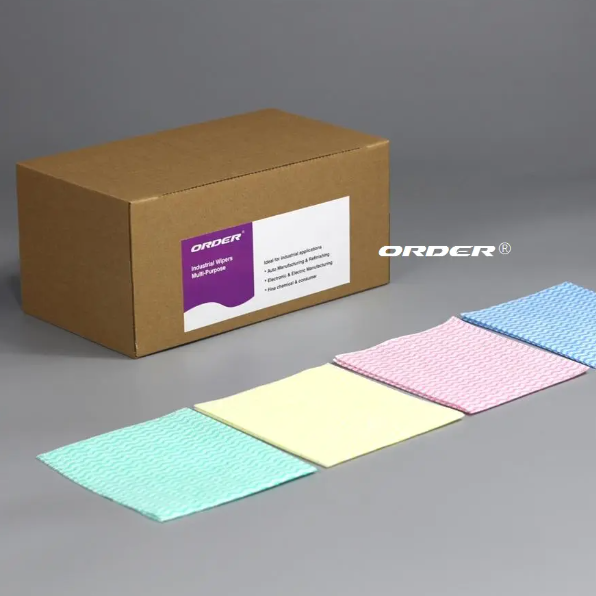
Quat-based wipes provide a non-corrosive alternative to bleach, while bleach remains a cheaper but more volatile option for general floor cleaning.
| Feature | Quat-Based Wipes | Bleach Solutions |
| Corrosivity | Very Low (Safe for metals) | High (Causes pitting in steel) |
| Stability | High (Stable for months) | Low (Degrades in 24 hours) |
| Odore Impact | Low/Neutral | Strong Chemical Odor |
| Surface Safety | Excellent for prep tables | Requires careful dilution |
Suzhou Order Cleanroom Material Co., Ltd. was established in 2006. The company is headquartered in Suzhou City and specializes in nonwoven fabric cleaning products. It operates a 12,000-square-meter modern production base. The company ensures full-process quality control from raw materials to finished products through a digital management system. With 20 years of industry experience, the enterprise supports global customers with high standards and refined manufacturing.
Efficiency in a busy kitchen requires products that are easy to access and cost-effective. Purchasing bulk food service sanitizing wipes for commercial kitchens reduces the price per unit and ensures that staff never run out of supplies during peak hours. In the "Front of House" areas, customer perception is equally important. Using disposable sanitizing wipes for food service front of house areas like dining tables and condiment stations shows customers that the establishment prioritizes hygiene.
| Method | Disposable Wipes | Reusable Rags & Buckets |
| Chemical Accuracy | Pre-mixed & Consistent | Prone to mixing errors |
| Cross-Contamination | Zero risk (Single use) | High risk (Bacteria buildup) |
| Labor Cost | Low (Grab and go) | High (Washing/Drying/Mixing) |
Q1: Do these wipes require a water rinse after use on a cutting board?
If you use a "no-rinse" certified food service wipe, you do not need to rinse with water. The formula is designed to evaporate safely.
Q2: Can I use these wipes on my hands?
Most food contact surface wipes are designed for hard surfaces. You should check the label to see if the formula is also safe for skin or if it is strictly for equipment.
Q3: How long do the wipes stay effective once the tub is opened?
High-quality tubs feature moisture-lock lids. Generally, the wipes stay effective for 30 to 90 days if the lid is closed properly after every use.
Q4: Are biodegradable options as strong as standard nonwoven wipes?
Yes, modern biodegradable fibers like polylactic acid (PLA) or viscose provide excellent scrubbing power and tensile strength while being eco-friendly.
Q5: Why is the EPA registration number important?
The EPA number proves that the product has been tested by third parties to confirm it actually kills the germs listed on the label.
If you are interested in our products, please consult us

 contact us


 English
 日本語
日本語
 简体中文
简体中文