2026.01.08
 Blog
Blog
Content
In the highly regulated world of semiconductor, pharmaceutical, and aerospace manufacturing, the smallest microscopic particle can lead to catastrophic batch failures or equipment malfunctions. The wiper cleanroom serves as the frontline defense in contamination control, acting not merely as a cleaning tool but as a precision-engineered instrument designed to maintain the equilibrium of a controlled environment. As we progress into 2026, the industry is moving away from generic wiping solutions toward high-purity, substrate-specific textiles that minimize the risk of cross-contamination. Selecting a wiper involves a complex evaluation of fiber type, edge sealing technology, and chemical compatibility. A high-quality wiper must demonstrate exceptional cleanliness, high absorbency, and minimal extractable levels to ensure that the process of "cleaning" does not inadvertently introduce new contaminants into the cleanroom air or onto critical surfaces.
The material composition of a wiper cleanroom dictates its performance in specific ISO classes. For the demanding needs of biotech and drug manufacturing, a lint free polyester wiper cleanroom for pharmaceutical use is the industry gold standard. These wipers are typically knitted from continuous filament polyester, which offers inherent strength and virtually zero fiber shedding. The edge finishing is equally important; laser or ultrasonic sealing melts the fabric edges to prevent loose threads from escaping. When compared to traditional blended wipers, 100% polyester versions provide a much cleaner profile, making them suitable for ISO Class 3-5 environments where particle counts are strictly monitored. Our advanced knitting techniques ensure a soft hand-feel that protects delicate equipment while maintaining a rugged structure that resists snagging on sharp metal edges.
| Wiper Material | Particle Generation (per m2) | Fiber Shedding Risk | Cleanroom Class Suitability |
| Cotton / Poly Blend | High | Significant | ISO Class 7-8 |
| Non-Woven Polypro | Moderate | Moderate | ISO Class 6-7 |
| Lint free polyester wiper | Extremely Low | Near Zero | ISO Class 3-5 |
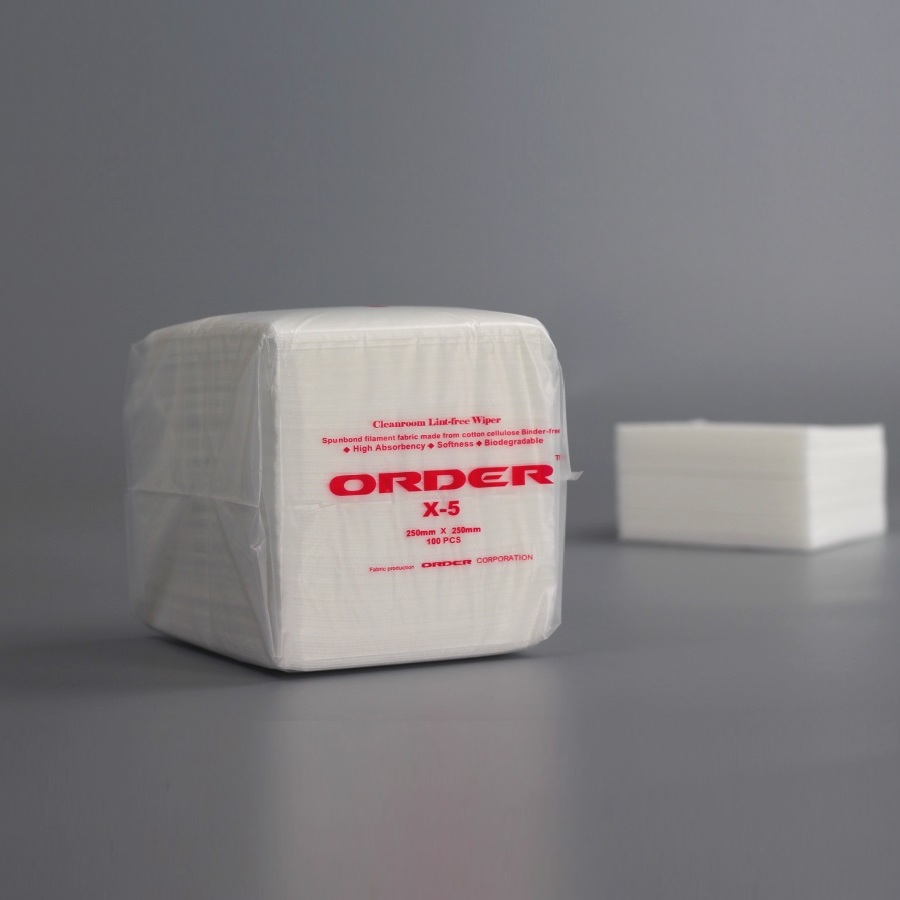
Efficiency in modern electronics assembly is often measured by the precision of chemical application. The use of a pre-saturated isopropyl alcohol wiper cleanroom for electronics has seen a massive surge as manufacturers seek to standardize their cleaning protocols. These wipers come pre-wetted with a precise ratio of 70% Isopropyl Alcohol (IPA) and 30% Deionized (DI) Water, enclosed in resealable pouches to prevent solvent evaporation. This system eliminates the inconsistencies and safety hazards associated with manual solvent spraying or "squirt bottles," which can lead to over-saturation and erratic VOC levels in the cleanroom. By controlling the saturation level, engineers can ensure a uniform thin film of solvent that evaporates quickly and leaves no residue, which is vital for the integrity of circuit boards and micro-components.
| Cleaning Method | Solvent Waste | Saturation Uniformity | Safety Level |
| Dry Wiper + Spray Bottle | High (Overspray) | Inconsistent | Lower (Bulk Liquids) |
| Pre-saturated IPA wiper | Minimal | Excellent / Precise | Higher (Contained) |
In life science sectors, the presence of viable microbes is as dangerous as physical particles. This necessitates a sterile non-woven wiper cleanroom for ISO class 5 environments, which must undergo validated sterilization processes such as Gamma Irradiation to achieve a Sterility Assurance Level (SAL) of 10-6. These non-woven substrates, often made from hydroentangled polyester and cellulose, offer excellent absorbency for cleaning spills or applying disinfectants in aseptic processing areas. Under the 2025-2026 USP and Annex 1 guidelines, sterile wiping is a mandatory component of contamination control strategies (CCS). Our sterile wipers are triple-bagged and lot-traceable, ensuring that every piece of material entering the sterile suite meets the most rigorous regulatory documentation requirements.
| Wiper Type | Sterility Method | Absorption Capacity | Primary Industry |
| Non-Sterile Polyester | None | Moderate | General Semiconductor |
| Sterile non-woven wiper | Gamma Irradiation | Very High | Pharmaceutical / Biotech |
Optical manufacturing requires a delicate balance between cleaning power and surface protection. A high strength microfiber wiper cleanroom for optical lens cleaning is designed with wedge-shaped synthetic fibers that are significantly thinner than a human hair. This unique structure allows the wiper to penetrate microscopic surface textures and lift oil, grease, and fingerprints without the need for excessive pressure. Unlike standard polyester, microfiber increases the surface contact area by a factor of three, allowing it to "trap and hold" contaminants rather than just moving them around. This is essential for the 2026 generation of high-precision lenses and sensors used in LIDAR and aerospace imaging systems, where even a sub-micron scratch can degrade the performance of the entire optical assembly.
For procurement managers, the goal is to balance operational costs with risk mitigation. Securing a wholesale absorbent wiper cleanroom bulk supply 2026 allows large facilities to maintain a consistent supply chain while benefiting from economies of scale. However, the true value of a wiper is not its purchase price, but its "cost-per-clean." An ultra-absorbent wiper may be more expensive per unit, but if it allows a technician to clean a surface in one pass instead of three, the savings in time, labor, and solvent usage are substantial. Furthermore, high-quality wipers reduce the risk of batch rejections, which can cost millions in lost revenue. As a premier supplier, we provide comprehensive technical data sheets and free sampling programs to ensure our bulk clients receive the most cost-effective wiping solution for their specific cleanroom class.
| Procurement Factor | Low-Grade Economy Wiper | Wholesale absorbent wiper |
| Wipers per Cleaning Task | 3 - 5 units | 1 - 2 units |
| Solvent Waste | High (Poor Absorption) | Low (High Retention) |
| Risk of Batch Failure | Higher (Particle Shedding) | Minimized (ISO Certified) |
The choice depends on your environment and task. For critical areas like ISO Class 3-4, a lint free polyester wiper cleanroom for pharmaceutical use is preferred because it generates the fewest particles. For general cleaning or spill control in ISO Class 6-7, non-woven wipers are more absorbent and cost-effective. Always match the wiper's cleanliness rating to your specific cleanroom classification.
Yes, especially for electronics. A pre-saturated isopropyl alcohol wiper cleanroom for electronics ensures a consistent saturation level, which prevents the "puddling" of solvent on circuit boards. It also improves safety by reducing the amount of flammable vapor released into the air and eliminates the risk of contaminated spray nozzles.
SAL stands for Sterility Assurance Level. A SAL of 10-6 is the pharmaceutical industry standard, meaning there is only a one-in-a-million chance of a single viable microbe being present on the sterile non-woven wiper cleanroom for ISO class 5 environments. This is achieved through validated Gamma Irradiation processes.
Generally, no. A high strength microfiber wiper cleanroom for optical lens cleaning is engineered to be extremely soft. However, scratches are often caused by dust particles trapped between the wiper and the surface. It is crucial to use a fresh, clean side of the wiper for each pass and to use a "Z-wipe" pattern to lift particles away from the surface.
Sourcing a wholesale absorbent wiper cleanroom bulk supply 2026 provides significant cost savings and ensures that your facility has a standardized cleaning material. Batch-to-batch consistency is critical for maintaining your validated cleaning protocols, and bulk sourcing from a single manufacturer ensures that your SOPs (Standard Operating Procedures) do not need to be updated due to material changes.
If you are interested in our products, please consult us

 contact us


 English
 日本語
日本語
 简体中文
简体中文