2026.10.15
 Blog
Blog
Content
A fish-eyed paint edge, a bracket that fails a peel test, or a particle count that drifts upward in an avionics bay usually traces back to something mundane: the wipe used two steps earlier. Aerospace cleaning wipes are not chosen on softness or price per box. Three variables decide whether the choice survives an audit — how clean the fiber is (particles, loose fibers and non-volatile residue), how it behaves against the solvents the process really uses, and whether the format fits the task and the dispenser at the point of use.
The practical rule is to specify from the contamination requirement backward. A bond line or primer coat needs a low-lint, low-extractable wipe that leaves no silicone or oil film behind. Engine and landing gear work needs a solvent-tolerant meltblown polypropylene that captures oil instead of smearing it across a wider area. Size, fold, packaging and dispenser choice follow from those two starting points, not the other way around.
Aerospace work overlaps with general industry, but acceptance criteria are tighter. Shops run AS9100-based quality systems, and the cleaning steps around bonding, sealing, painting and electrical assembly sit inside a contamination-control plan. Critical areas are classified to ISO 14644-1, typically ISO 5 through ISO 8, and wipers used in them are evaluated with methods such as IEST-RP-CC004.3, which covers particle shedding, fiber release, non-volatile residue and absorbency.
That is why a wipe sold for general factory maintenance is rarely a safe substitute. Failure modes are predictable: silicone picked up from an unqualified wipe, cellulose fibers trapped under a primer, lint inside a connector, or an oil film left behind because the sheet released liquid instead of holding it.
Aerospace cleaning wipes appear in five recurring situations:
Fiber chemistry drives everything downstream. The five families below cover most aerospace wiping tasks, and the differences that matter are solvent resistance, particle and fiber release, and how much liquid the sheet holds.
| Fiber family and construction | Typical aerospace use | Strengths | Watch-outs |
|---|---|---|---|
| Meltblown polypropylene | Sealant and adhesive removal, oil and hydraulic cleanup, engine bays | High solvent and oil absorbency; survives MEK and acetone contact | Higher extractables than laundered polyester; verify NVR before use on critical bond lines |
| Cellulose and polyester hydroentangled | Tooling, jigs and general shop wipe-down; large-area jumbo rolls | Good absorbency at low cost per sheet; abrasion resistant | Cellulose contributes particles and fibers; keep away from primer and bonding surfaces |
| Viscose and polyester spunlace | Pre-paint wipe-down, panel and interior cleaning, avionics bench work | Soft hand, low lint on dry surfaces, good wet strength | Check NVR ahead of bonding; absorbency below meltblown PP |
| Knitted polyester, laundered | ISO 5 to 7 critical cleaning, optics, transparencies, dispensing equipment | Lowest particle and fiber release in its class; sealed-edge options | Highest unit cost, lower absorbency, needs a compatible solvent to avoid smearing |
| Split microfiber, polyester and nylon | Final polish, cabin and cockpit surfaces, screens and panels | Holds liquid well and lifts fine films | Use with mild solvents; aggressive ketones shorten service life |
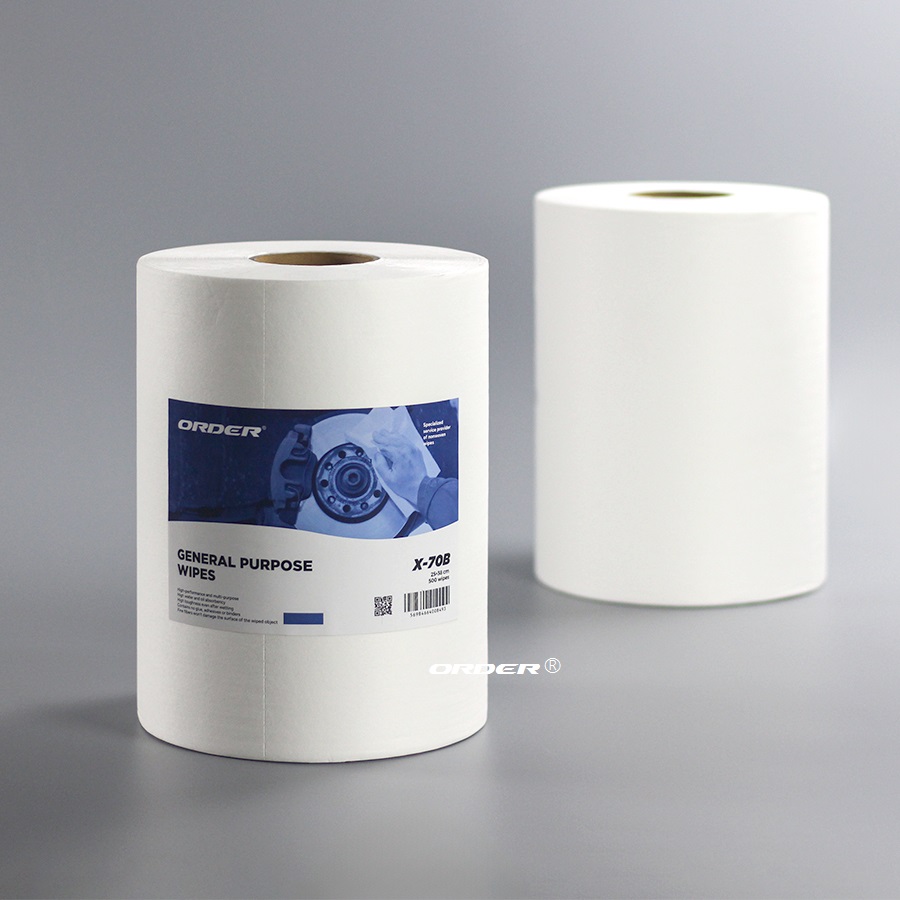
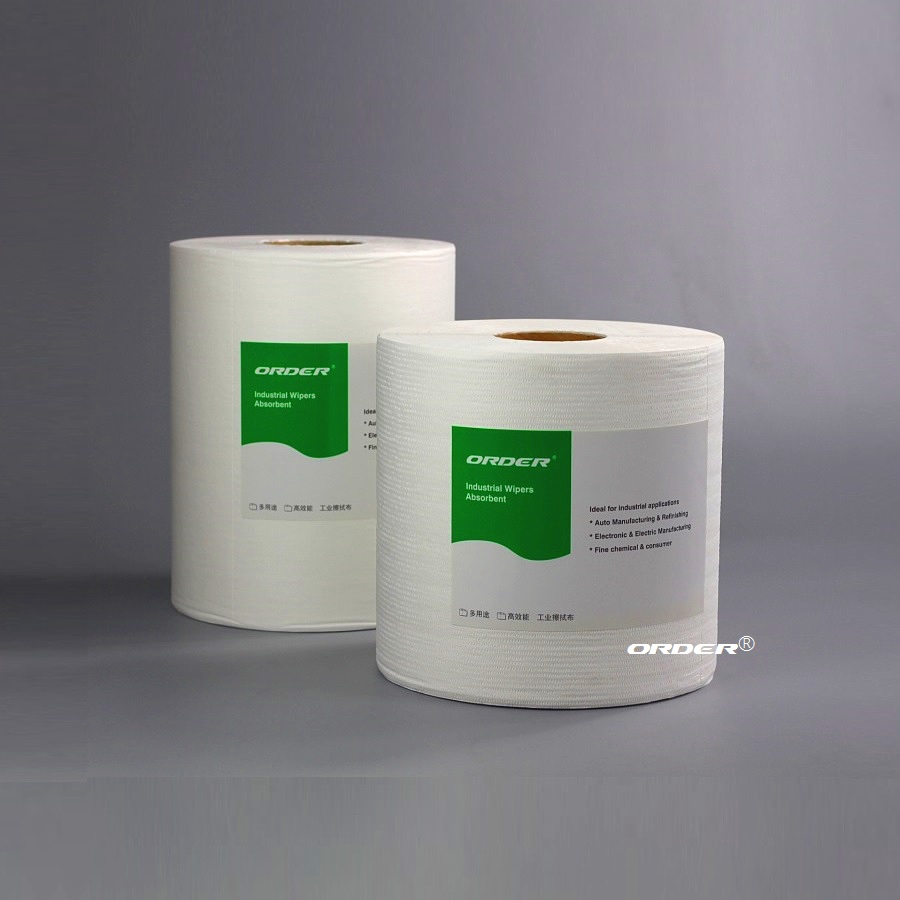
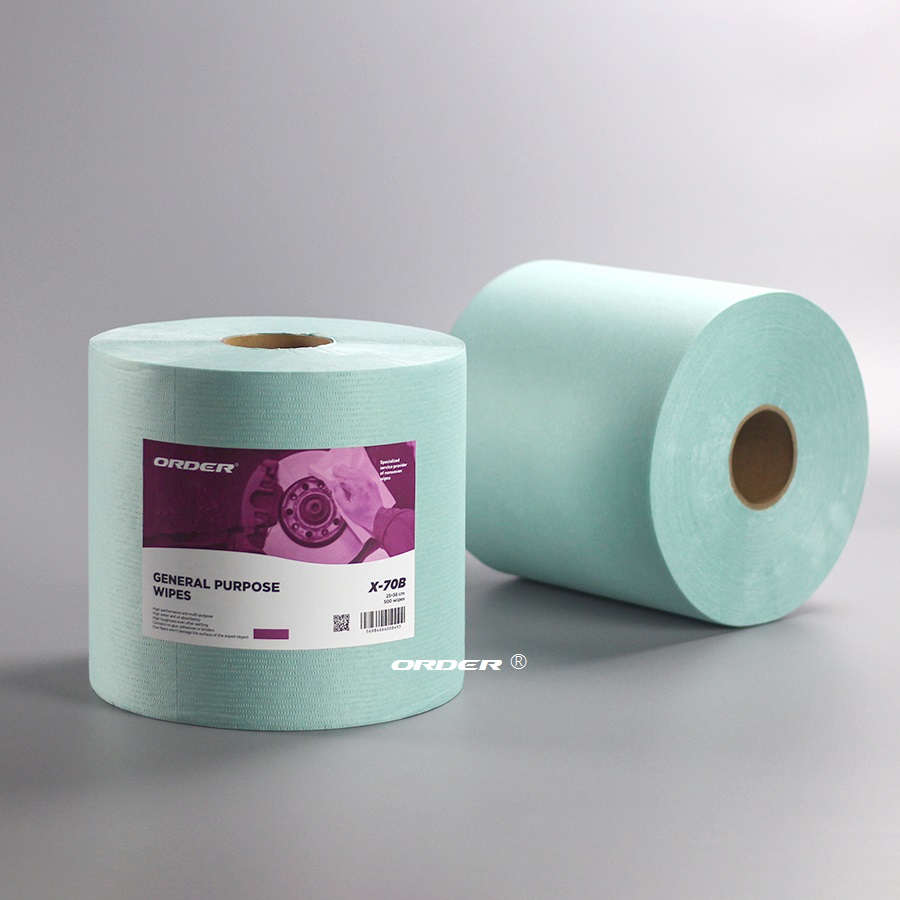
For large-area surface preparation on skins and panels, a perforated jumbo roll is often the most practical format: the operator tears a fresh sheet without touching the working face of the roll, and consumption stays predictable across a shift.
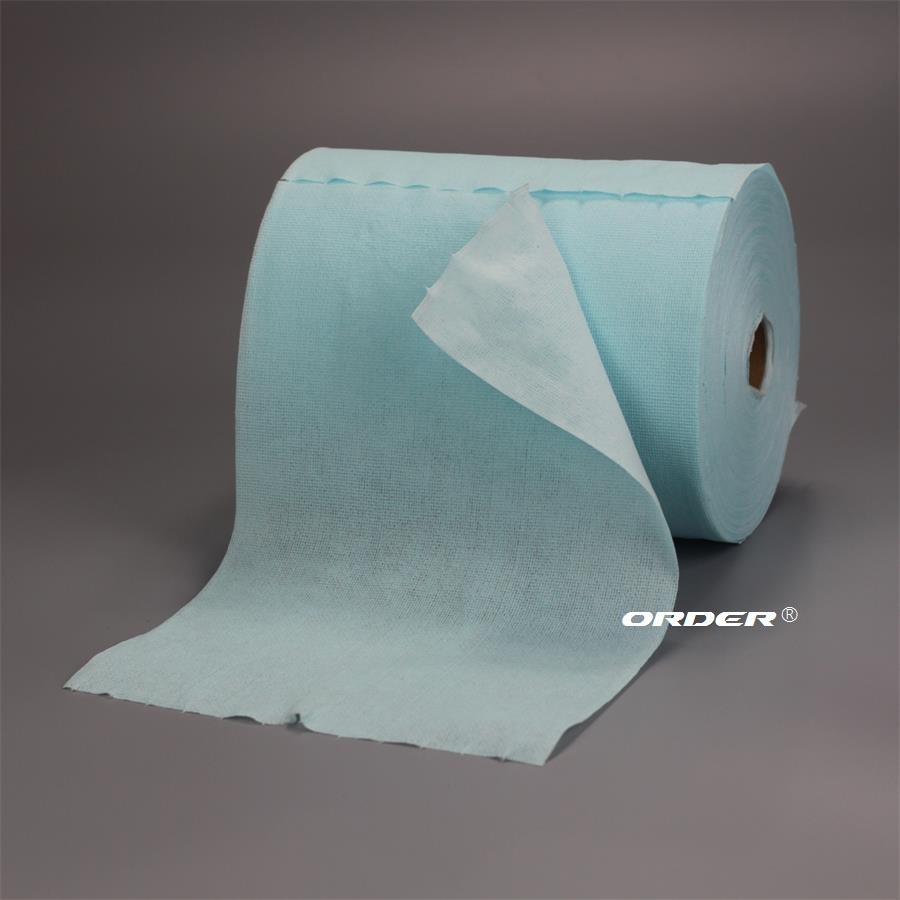 ORDER HD-1 Automotive Surface Preparation Jumbo Roll ClothsHeavy-duty turquoise cellulose-polyester wipes on a perforated jumbo roll for solvent-resistant automotive degreasing and large-area surface prep.View Product →
Aerospace solvents are not gentle. MEK, acetone, isopropyl alcohol, aqueous alkaline cleaners and proprietary adhesion promoters are all in daily use, and a wipe has to stay intact in contact with them. Meltblown polypropylene and polyester-based products tolerate the ketones and alcohols found in most shops. Cellulose-heavy wipes soften and break apart when they stay wet with aggressive solvents, which converts a cleaning step into a contamination event.
Pre-saturated wipes add convenience and add risk. Sealed, individually packed IPA wipes suit connector and optics work, but the supplier should document solvent concentration, seal integrity, shelf life and the use window once a pack is opened. Silicone remains the most damaging contaminant for bonding and painting, so wipes must be free of silicone and fabric softeners, and laundered knitted products should run on a dedicated line — no optical brighteners, no shared loads with general shop textiles.
Format is the cheapest place to lose or gain efficiency. The same fiber in the wrong presentation doubles consumption and adds handling steps.
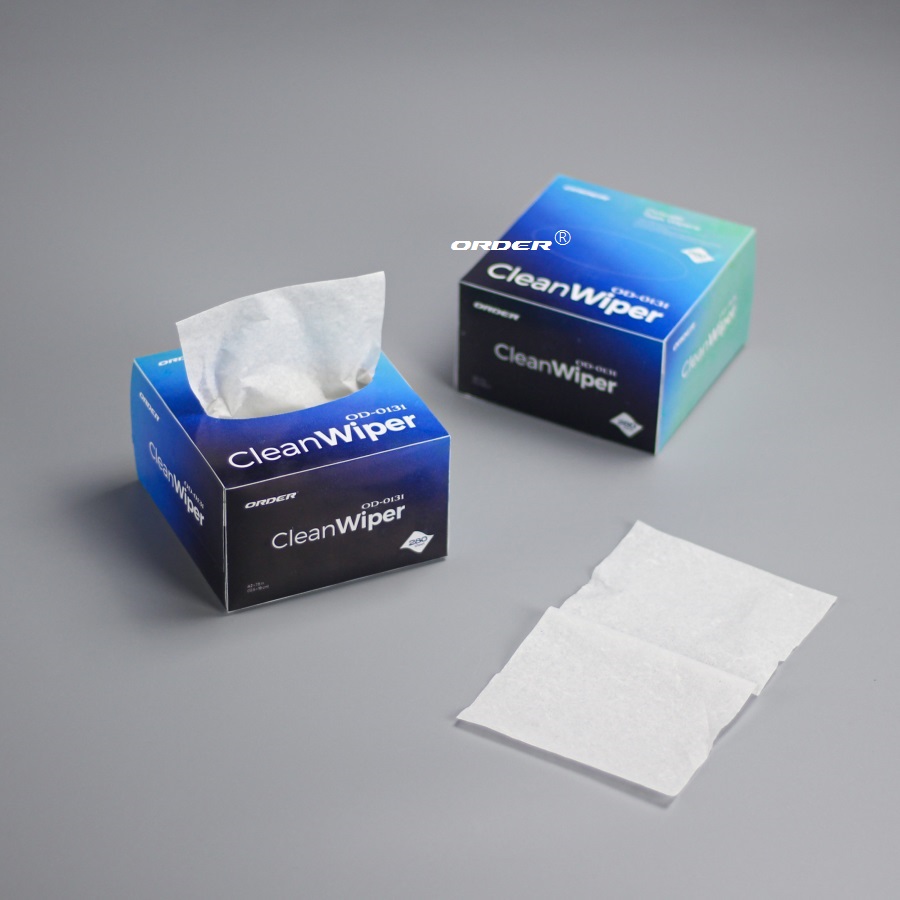
For paint preparation, an apertured 1/4-fold wipe gives the operator a fold that holds its shape against a vertical surface and a texture that lifts dust rather than pushing it along the panel.
 ORDER Turquoise Apertured 1/4 Fold Paint Prep WipeApertured cellulose-polyester 1/4-fold wipe for paint prep, dust lifting, and solvent-resistant critical cleaning on vertical surfaces.View Product →
Most wipe disputes start with a purchase description that says "cleanroom wipes, 9 x 9 inch" and nothing else. Pin down the following before releasing a purchase order:
Oil-heavy maintenance bays follow a different logic from paint shops: the wipe has to hold grease and hydraulic fluid without dissolving, which is where a heavy-duty blue jumbo roll earns its place in workshop programmes.
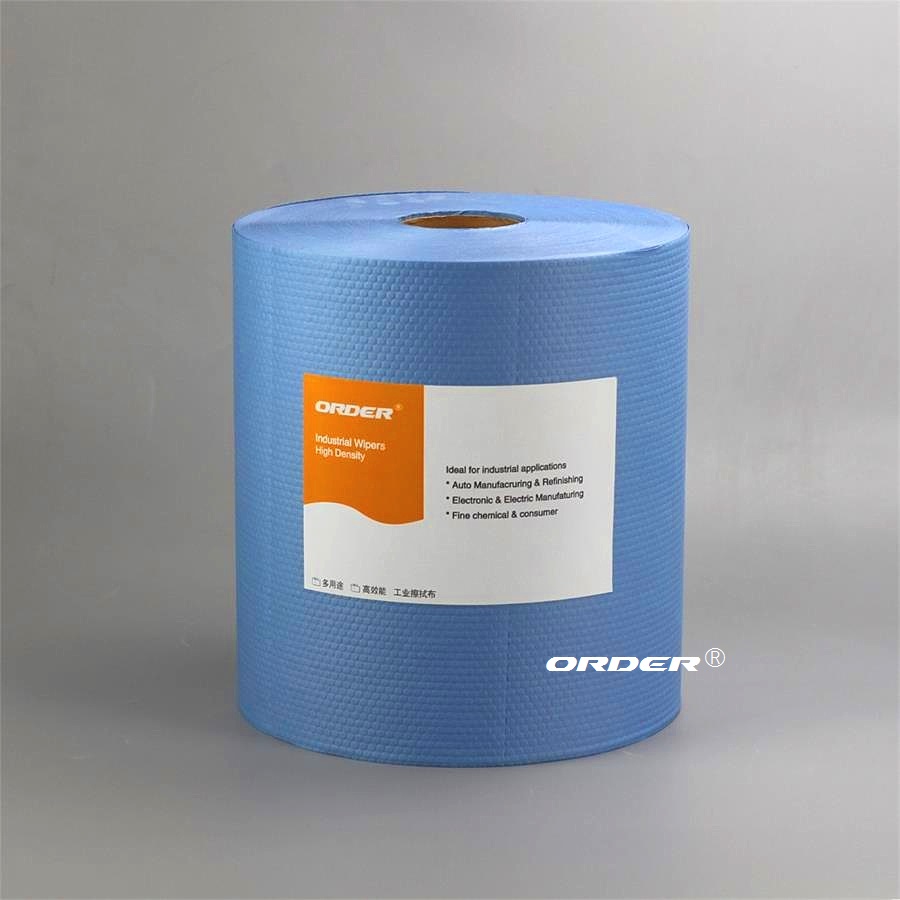 ORDER KIM-X80 Blue Heavy-Duty Jumbo Roll Cleaning ClothsBlue woodpulp-polypropylene jumbo roll for grease, oil, and heavy industrial maintenance; strong, absorbent, and reusable with solvents.View Product →
The biggest general risk is a silent substitution. A replacement-style wipe may match a well-known brand on sheet size while differing by ten percent in basis weight and in how quickly it disperses solvent. That is not automatically a problem — many plants run substitute products successfully — but the acceptance test has to be defined by your process, not by the marketing comparison.
Three more risks deserve attention. Contamination during freight and storage can ruin a compliant product, because a carton left open in a dusty warehouse no longer meets its ISO class. Counterfeit or repackaged branded wipers still circulate, so lot traceability matters more than a familiar name. Dispenser compatibility is easy to overlook as well: a jumbo roll that does not fit the existing floor stand becomes manual handling for an entire shift.
Order Cleanroom has been converting nonwoven wiping products since 2006 from a plant of roughly 12,000 square metres in Suzhou, and supplies industrial, cleanroom, electronic, medical and food-service wipes to customers in more than 30 countries. For aerospace buyers, the relevant point is having several substrates in one place — meltblown polypropylene, hydroentangled cellulose and polyester, and viscose and polyester spunlace — plus folding, slitting, roll converting and OEM or ODM work on dimensions, basis weight, colour and packaging.
That matters when a plant needs the same wipe in three formats: a jumbo roll for hangar-scale work, a 1/4-fold box for bench work, and a small flat sheet for optics. Sourcing all three from one converter keeps the fiber specification consistent, which simplifies the qualification file. If you are still mapping materials to cleanliness classes, our guide to cleanroom cloth materials and ISO class selection is a reasonable starting point before requesting samples.
Sample quantities, dispenser fit and custom sizes are usually the fastest way to test a supplier. Send the wipe specification you are working to and ask for the matching particle, NVR and absorbency documentation to arrive with the samples, so the trial and the paperwork move together.
Buying decisions in this category are rarely settled by a catalogue. Run a two-week trial on the three dirtiest and the three most critical tasks in your own shop, count the sheets used per task, and compare the certificates against your process specification. A wipe that costs more per box but removes one rework hour per week is the cheaper option every time — and it is the one that still looks correct when the auditors arrive.
If you are interested in our products, please consult us

 contact us


 English
 日本語
日本語
 简体中文
简体中文