2026.08.12
 Blog
Blog
Content
A purchasing manager evaluating a new supplier for non woven wipes often runs into the same problem: the lowest quoted price looks good on paper, but the first case of wipes that shreds during use or leaves lint on a finished surface costs far more in rework and downtime. The practical way to avoid that cycle is to assess a supplier's material know-how, production control, and customization flexibility before committing to a volume order. Rather than focusing on unit price alone, start with these structural checkpoints.
A non woven wipes supplier is only as reliable as its control over fiber selection, converting processes, and final inspection. Unlike woven textiles, nonwoven wipes are formed directly from a fiber web, bonded by heat, chemicals, or hydroentanglement. That means the fiber recipe, the bonding method, and the converting line (folding, slitting, perforating) determine how the wipe performs in your operation.
A competent supplier should be able to state the basis weight in grams per square meter (gsm), the fiber composition, and the approximate absorbency of each grade. If a supplier can only give you a product name and a price, you are not actually comparing products. Ask for specifications in writing, request samples, and run a small trial in your own workshop before scale-up.
Nonwoven wipes are not a single product. The right material depends on the surface, the contaminant, and the cleanliness requirement. Most B2B purchasing falls into three material families.
Meltblown polypropylene is formed from ultra-fine polypropylene fibers thermally bonded into a dense web. The material is naturally oleophilic, so it picks up oil and grease quickly; it also withstands common industrial solvents. Workshops use it for machine maintenance, degreasing, printing press cleanup, and paint prep. A typical basis weight for these wipes is 40 to 80 gsm.
When a facility needs a durable cloth for oil spills and solvent-based cleaning, a product such as meltblown polypropylene oil absorbency industrial wiping cloths is a common choice. The key specification to verify is wet strength: a low-quality meltblown sheet can fall apart when it is saturated with solvent.
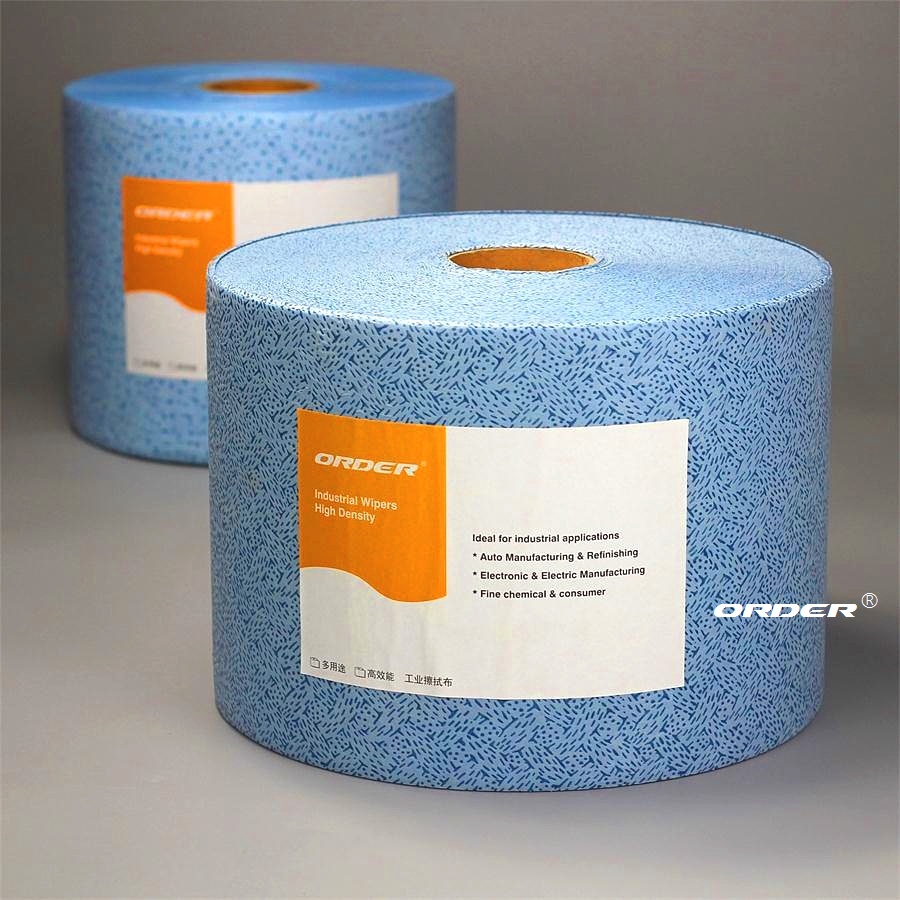 Wholesale ORDER® X-3331B Meltblown Oil Absorbency industrial multi purpose cleanSuzhou Order Cleanroom Material Co., Ltd is China wholesale ORDER® X-3331B Meltblown Oil Absorbency industrial multi purpose cleaning Clo...View Product →
Spunlace nonwoven fabrics are made by entangling fibers with high-pressure water jets. Viscose/polyester and wood pulp/polyester blends are the most common compositions. These wipes absorb water-based liquids quickly, feel soft, and hold up well in repeated wiping. Kitchens, restaurants, and janitorial operations use them for dish drying, counter wiping, and general food-contact cleaning.
For food service, confirm that the wipes contain no optical brighteners or prohibited additives, and check the sheet size and count per pack. A standard commercial configuration is around 13.7 by 24 inches. Suppliers such as heavy-duty food service industry wipes in a 60-piece pack are typical for kitchen environments where staff go through multiple wipes per shift.
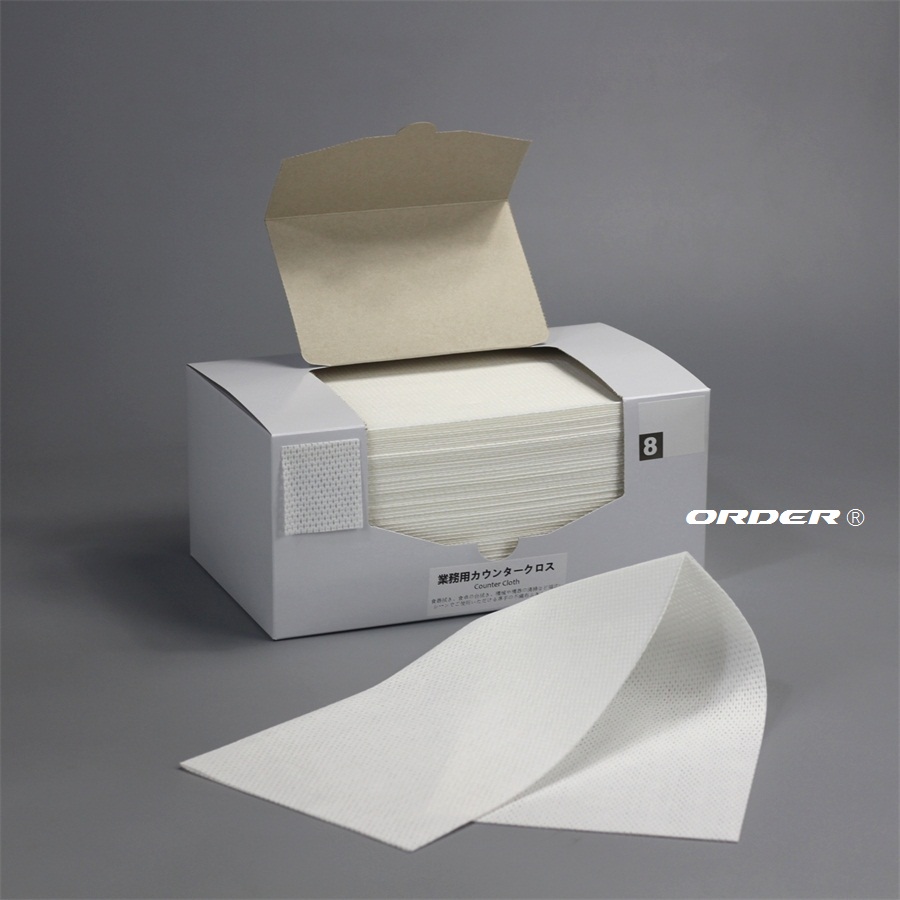 Wholesale Food Service Industry Wipes 60PCS Heavy-Duty,13.7”x24” Suppliers, FactSuzhou Order Cleanroom Material Co., Ltd is China wholesale Food Service Industry Wipes 60PCS Heavy-Duty,13.7”x24” suppliers and Food Ser...View Product →
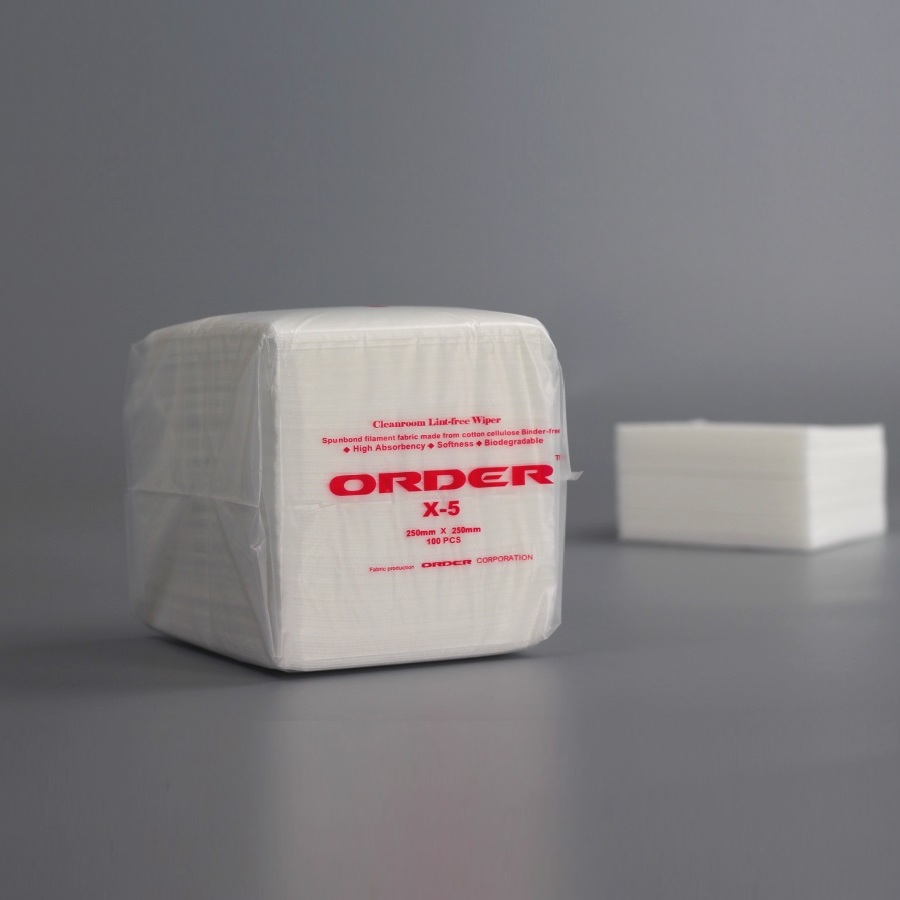
Electronics assembly, optics, semiconductor, and medical device environments cannot tolerate lint, fibers, or ionic residues left behind by ordinary wipes. Cleanroom wipes are usually made from continuous-filament polyester or polyester/cellulose blends and are cut and packed inside a cleanroom to control particle shedding.
The critical data is not the brand name but the measured performance: particle counts, non-volatile residue (NVR), and ionic content. Use cleanroom wipes that carry documented test data and match the ISO class of your environment. A good example is lint-free highly absorbent cleanroom nonwoven wipers, which are designed for delicate instrument cleaning where low particle generation and high absorbency both matter.
 Wholesale ORDER®WIP-0609 lint free highly absorbent cleanroom non-woven dust-freSuzhou Order Cleanroom Material Co., Ltd is China wholesale ORDER®WIP-0609 lint free highly absorbent cleanroom non-woven dust-free clean...View Product →
For many buyers, the deciding factor is not the standard catalog but how far the supplier is willing to adapt. OEM / ODM production of non woven wipes commonly involves:
A supplier that operates its own converting line can adjust these variables without moving your order to a third party. That also shortens lead times and makes quality control more consistent. Ask the supplier to produce a pre-production sample with your required dimensions and packaging before volume manufacturing starts.
It is equally useful to work with a supplier that takes time to understand your application. Teams that understand how to select the right cleaning wipe for your business will ask about your contaminant, your surface sensitivity, and your staff's usage habits before recommending a grade. If you only exchange price inquiries, you miss the information that actually drives cost and performance.
Once a supplier passes the document review, run these five checks on product samples before the first container or pallet is ordered.
| Check | What to Verify | Why It Matters |
|---|---|---|
| Material consistency | Basis weight (gsm), fiber blend ratio, batch records | Large gsm variation leads to inconsistent absorbency in use. |
| Dimensional tolerance | Sheet size, fold accuracy, roll width | Size deviation can jam automatic dispensers and waste material. |
| Absorbency and wet strength | Water and oil absorption time, tear strength when wet | These determine how quickly tasks are done and whether wipes tear during heavy wiping. |
| Linting and residue | Particle counts, NVR, ionic content (for cleanroom) | Residue on sensitive surfaces affects product yield and quality. |
| Packaging and shelf life | Seal integrity, moisture protection, label marking | Damaged packaging can contaminate wipes before they reach your line. |
If a supplier hesitates to share test reports or cannot explain its quality control process, treat that as a warning signal. A well-run factory maintains incoming material inspection, in-process checks, and final inspection records for each batch.
The lowest per-piece price is rarely the lowest total cost. Consider what happens when a wipe sheds fibers on an automotive paint line, leaves residue on an optical lens, or disintegrates halfway through a degreasing task: rework, scrapped parts, and lost production time all belong to the real cost calculation. When a supplier offers stable quality and traceable records, those risks are reduced even if the unit price is not the lowest.
That does not mean price is secondary. The goal is to define a specification that matches the task, then compare suppliers on that specification. For many applications, a light-duty wipe is enough and a heavy-duty version would be overpaying; for others, only a cleanroom-grade material makes sense. This is how professional buyers find the balance between price and quality when evaluating non woven wipes suppliers.
Order Cleanroom, a nonwoven wipe manufacturer based in Suzhou, China, illustrates the kind of profile worth looking for. Founded in 2006, the company operates a roughly 12,000-square-meter production base and covers industries from industrial maintenance and electronics to food service and healthcare. Its position as both a nonwoven fabric converter and finished-wipe manufacturer means customers can source standard products and OEM / ODM projects from one factory with a single quality system.
For a procurement team comparing non woven wipes suppliers, the practical value of this structure is that customization does not require coordinating multiple vendors. The factory can control material selection, converting, and packaging under one roof, then ship to customers in more than 30 countries. If you have a specific application and want to test whether a manufacturer can match your specification, contact the factory directly with your sample or drawing and ask for a detailed quote.
In short, the right supplier is not necessarily the one with the lowest quote. It is the one that can document its material, control its processes, and respond to your application with samples and data. Start there, and the price conversation becomes far easier.
If you are interested in our products, please consult us

 contact us


 English
 日本語
日本語
 简体中文
简体中文